


Activities
See what happened inside an app: record activity and changes to lists, fields, reports, automations, and forms. Restore deleted items from here.


Activities shows a table of what happened inside an app: changes to records, and changes to the app's lists, fields, reports, automations, and forms. Use it to see who changed what and when, to review a change, or to restore a deleted list or field. For example, if a teammate accidentally deletes a field, you can find out who did it and bring the field back.
Note: Activities lives inside each app, in the app's sidebar next to Reports, Automations, and Forms. It always shows the app you have open.
Open Activities
- Open the app from the sidebar.
- In the app's sidebar, select Activities.
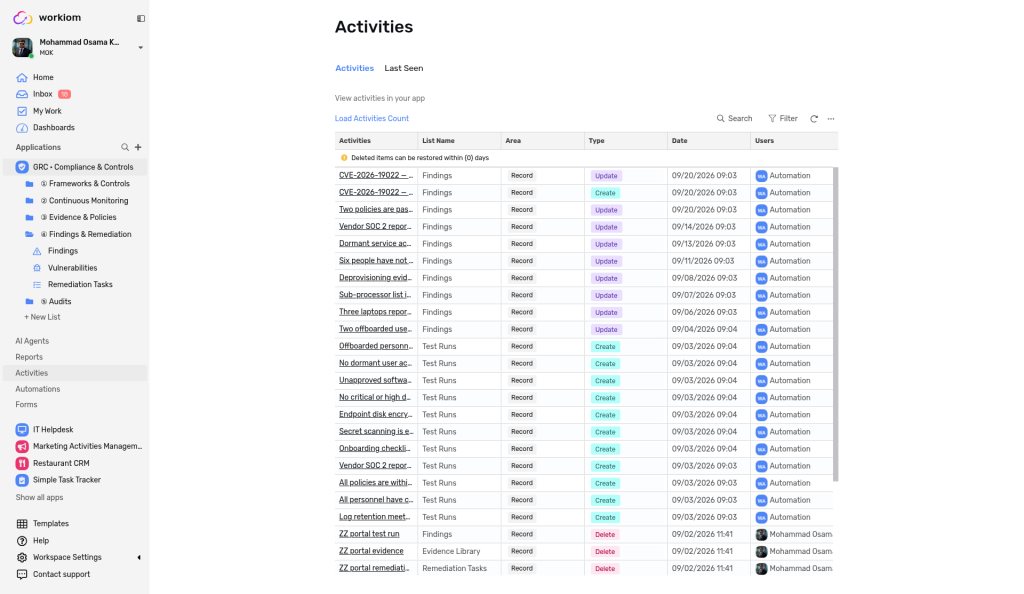
The page has two tabs, Activities and Last Seen, plus Search, Filter, and refresh controls above the table.
Read the Activities Table
Each row is one activity. The table includes:
- Activities: the name of what was affected, such as the record's main field or the name of the list, field, report, automation, or form
- List Name: the list where the activity happened. It's empty for list-level activities and for automations that aren't triggered from a list
- Area: the part of the app that was affected — Record, List, Field, Report, Automation, or Form
- Type: what happened
- Create: something new was created
- Update: something existing was changed
- Delete: something was deleted
- Record imports and bulk updates may also be logged as their own types.
- Date: when it happened
- Users: who did it
Select Load Activities Count to see how many activities match what's displayed in the table.
Search and Filter
Narrow the table to find a specific activity:
- Search: start typing an activity name
- Filter: open the filter panel to narrow by:
- Related List: show activities from one list in the app
- User: choose one or more users to see only their activities
- Action Type: choose one or more types, such as Delete
- Area: choose one or more areas, such as Field or Automation
- Date: pick a date range
Filters work together. For example, Area: Automation with Action Type: Delete shows only deleted automations. When you filter by Area: List, the Related List filter may be hidden because list activities aren't tied to a list.
See What Changed
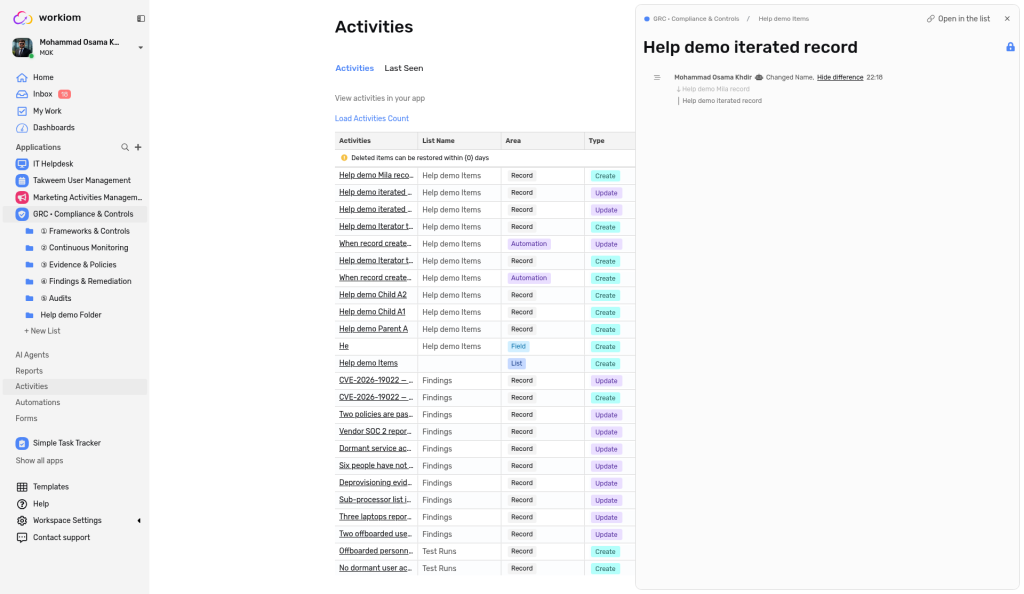
To see the details of an activity, select an Update row, or hover over a Delete row and select Open. The details open in a side panel. What the panel shows depends on the item:
- Record updates: the panel shows the record's name, and who changed which field (for example, Changed Name) and when, with a Hide difference link above the old and new values. Select Open in the list to go to the record.
- Lists, fields, and other items: the panel shows a DIFF, a technical JSON view of the item that includes internal IDs. Removed lines are marked in red with a minus (−), and added lines are shown in green with a plus (+). For a deleted item, Cancel and Restore buttons appear at the bottom of the panel.
See Who Opened a List
Open the Last Seen tab to see the last time users accessed lists in this app.
- Select the Last Seen tab.
- Optionally, select Filter to narrow the table.
- Read the table, which has three columns: User, List, and Last Seen. Recent visits show the time (for example, Today, 22:17), and older ones show the date and time.

Restore Deleted Items
Deleted lists and fields appear in Activities as Delete rows, and you can restore them from there for a limited time. You have 30 days to restore a deleted item. Deleted apps are restored from Workspace Settings > Audit log, which is available to Workspace Owners and Super Admins. See See Activity Across All Apps. The Audit log shows the same kind of restore banner.
- Find the Delete row, for example by setting Action Type to Delete.
- Hover over the row and select Open.
- Review the DIFF in the side panel, then select Restore.
A confirmation message, "Item restored successfully", appears. A restored field returns at the end of the list, and a view filter that used the field isn't restored. For deleted records, see Restore Deleted Records.
Activity Log Export
Export the Activities table with the before and after of each change, so you can audit changes outside Workiom. Workspace owners and super admins can export.
How to Export Activities
- Open Activities in your app.
- Set any filters you need, such as a person or a date range.
- Open the ⋯ menu next to the refresh control.
- Select Export To .csv or Export To .xlsx.
What Is in the File
- Previous Value and Record: both columns are always in the file. Create and Update rows fill them, Bulk Update rows fill Record only, and other types leave them empty.
- Readable values: fields export as the labels you see in Workiom, not as IDs.
- Several fields in one update: the changes share one row, written as
Field: Value | Field: Value. - Follows your filters: the file includes only what your current Activities filters show.
Example: Before a quarterly review, an operations lead filters Activities to one person, exports to .xlsx, and checks every Status change in the Previous Value and Record columns.
💡 Tip: Set your filters first, so the export matches what you see on screen.
See Activity Across All Apps
Workspace Owners and Super Admins can open the Audit log from Workspace Settings.
- Open Workspace Settings.
- Select Audit log.
- Use the Select Application dropdown to choose an app. The page is also titled Activities and works the same way, with an extra App name column.

What This Doesn't Cover
- Activities currently covers records, lists, fields, reports, automations, and forms.
- Deleted lists, fields, and apps can only be restored for a limited time.
Use Cases
- Business use case: A team lead notices a field is missing from the Deals list. They open Activities, set Area to Field and Action Type to Delete, find who deleted it and when, then hover over the row, select Open, and select Restore.
- Simple use case: You filter Activities by your own name and today's date to check which records you updated.
💡 Tip: Combine Area with Action Type to answer questions quickly — for example, Area: Automation + Action Type: Update shows every automation that was edited recently.
Need help? Reach out to our support team through the Workiom help center. For restoring records, see Restore Deleted Records.